
Community alerts
Wildping
Know before you step out.
When someone nearby spots wildlife, people with a watch zone over that spot get a heads-up. It works on Android, and on iPhones if you've added the app to your Home Screen.
Why Wildping exists
In a lot of places, people and large animals still use the same roads, farms, and forest edges. A leopard on the school path, an elephant in the fields, a bear by the village lane: these things still happen. What neighbours often don't have is a quick way to warn each other before someone walks into it.
Wildping is for that gap. Neighbours report what they see, and anyone with a watch zone over that spot gets a heads-up. It won't stop conflict by itself. It can buy a family a few minutes: keep the kids inside, skip the walk, or call for help.
The human cost of wildlife conflict
Conflict between people and wildlife is not rare. In many areas it's getting harder to ignore as homes and animals push into the same land. The official numbers below are only a slice: different countries, different years, and often just one species. Even so, they show how heavy the toll already is.
Bar length shows deaths, not injuries. The periods and scopes differ, so this is not one global total. These are separate official snapshots, and together they still run into thousands of lives lost.
India
2,727 deaths
2019–20 to 2023–24 · Elephant attacks alone
| Country | Period | deaths | Scope |
|---|---|---|---|
| India | 2019–20 to 2023–24 | 2727 | Elephant attacks alone |
| Sri Lanka | 1991–2018 | 1734 | Human–elephant conflict |
| Nepal | 2000–2020 | 887 | Elephant, rhino, tiger, leopard |
| Zimbabwe | 2016–2022 | 322 | Six major megafaunal species |
| Thailand | 2014–2023 | 189 | Human–elephant conflict |
| Kenya | FY 2024/25 | 131 | 131 deaths + 341 injuries nationally |
Sources summarised from government and official conflict datasets: India (elephant attacks, 2019–20 to 2023–24); Kenya (national HWC, FY 2024/25); Zimbabwe (six megafaunal species, 2016–2022); Nepal (elephant, rhino, tiger, leopard, 2000–2020); Sri Lanka (human–elephant conflict, 1991–2018); Thailand (human–elephant conflict, 2014–2023). Wildping does not replace wildlife authorities or emergency services.
How it works
No special gear. You sign in with email, drop a zone or two, and keep the app handy.
Mark places you care about
Home, farm, school, the path kids walk: each gets a watch zone. You can also keep a live “current location” radar while you’re out.
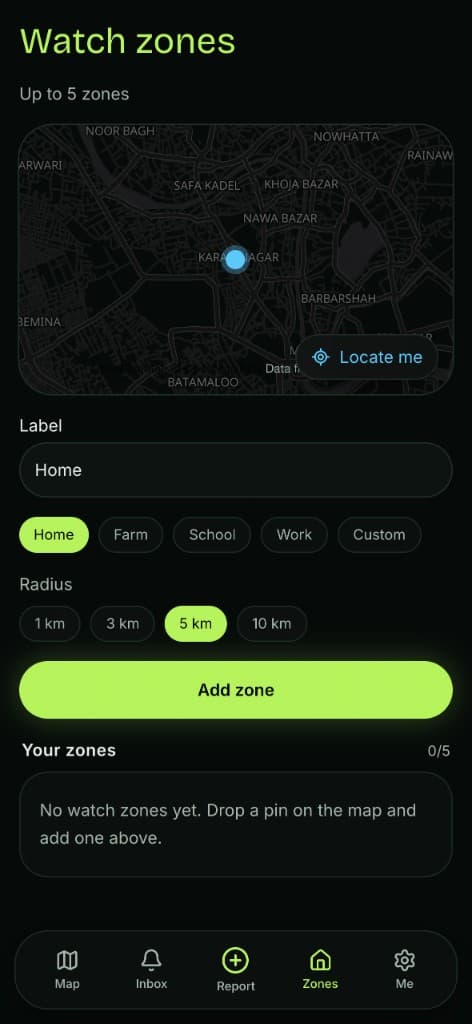
Watch zones
Someone reports a sighting
Three taps: pick the animal, confirm roughly where it is, send. The pin shows up on the map for others nearby.
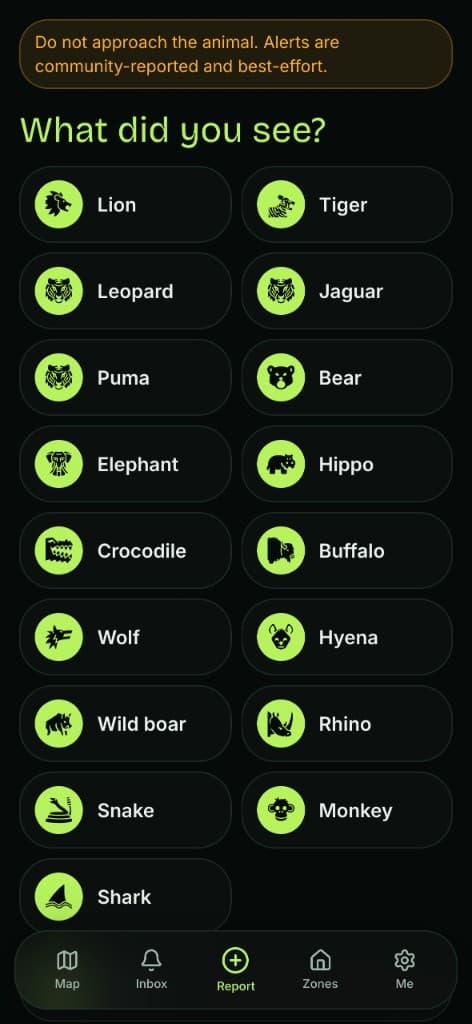
Report a sighting
See it nearby
When a pin lands inside one of your zones, it shows up on the map around you — so you can tell how close it is.
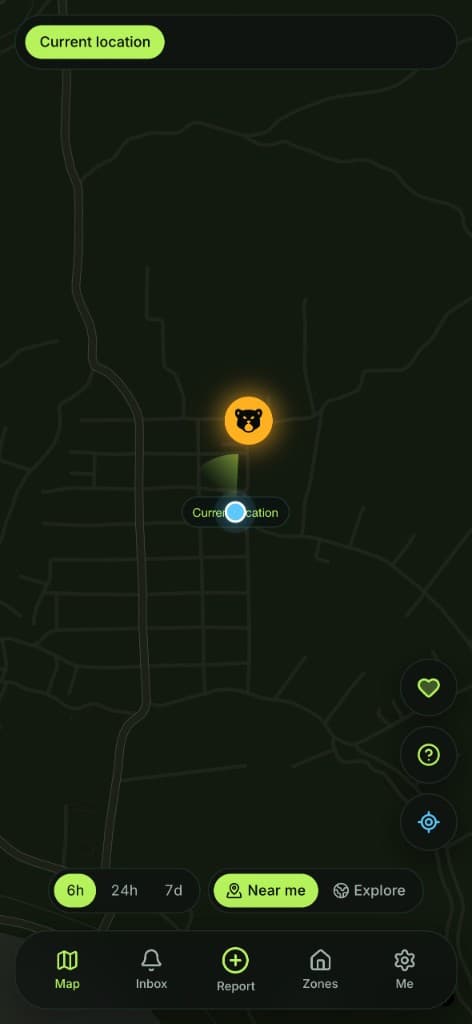
See it nearby
Open the alert
Wildping drops it in your inbox and can push a notification when you’ve allowed them — with distance and what to do next.
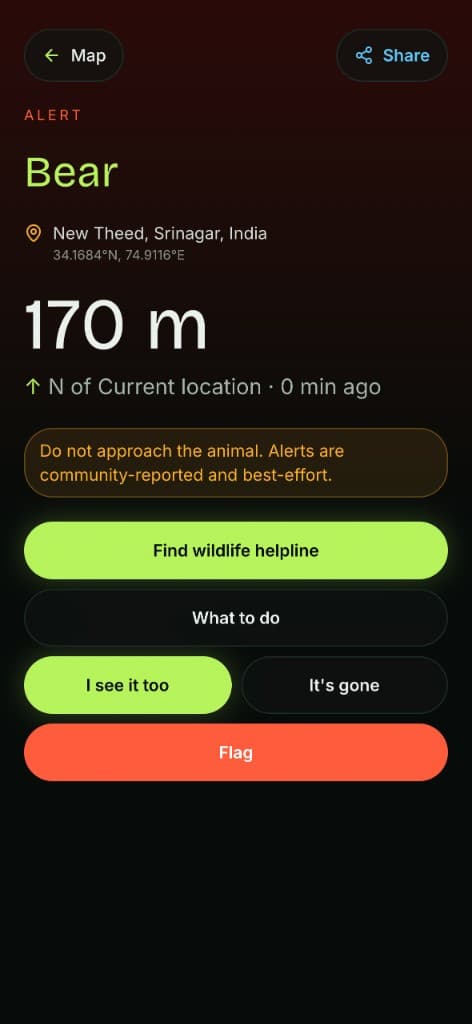
Open the alert
Trust & integrity
Keeping alerts honest
A wildlife alert only helps if people can trust it. Wildping is built so random bots and junk reports have a hard time getting through — without making the app hard for real neighbours to use.
Silent bot detection at sign-in
Before an OTP goes out, a background check scores the request for automated traffic — browser and network signals, not a puzzle you solve. Real people usually clear it invisibly; scripts and bulk account farms get blocked.
Limits on how often you can report
If someone tries to flood the map with dozens of reports in a short time, the app slows them down. Real sightings still go through; spam bursts do not.
Neighbours can flag bad pins
Anyone signed in can flag a report that looks wrong or harmful. Enough flags pull it off the map so one bad actor cannot keep scaring a whole village.
Live human moderation
Built-in tools let trusted volunteers and staff with elevated access pull false reports off the map in real time, so a bad pin does not keep alarming the neighbourhood.
Disposable junk inboxes are blocked
Throwaway email addresses often used for spam accounts are turned away at sign-in, so it is harder to hide behind a pile of fake logins.
Who this is for
Neighbours in places where animals still move through villages, farms, and town edges. People who want a quiet warning, not a social feed or a live tracker to chase anything with.
Safety first, always
Wildping does not tell you to go look. Reports are from people on the ground; they can be late, incomplete, or wrong. If someone is hurt or in danger, call local emergency services first. Use Settings → Helplines to search for wildlife contacts near you.
Phone tips
On Android, Chrome or Edge can install Wildping like an app. On iPhone, open this site in Safari, use Share → Add to Home Screen, then open Wildping from that icon before you turn on push alerts. Push does not work from a regular Safari tab.
Free for communities
There is no subscription. The project stays free for people using it; hosting still costs money, so tips via Support help keep the lights on.
Common questions
- Is Wildping free?
- Yes. Sign in, set zones, report, and get alerts at no charge.
- Do I need to download from an app store?
- No. It is a progressive web app. Install from the browser (Home Screen on iPhone; Install app on Android).
- Will I get alerts for animals far away?
- Alerts are for sightings that fall inside your watch zones (or your current-location radar). The Explore map can show wider context; Near me is for where you are now.
- What if a report is wrong?
- You can flag a sighting. Enough flags take it off the map. Treat every alert as a reason to be careful, not a guarantee of exact location.
- Which languages are supported?
- English, Hindi, and Urdu. Switch anytime in Settings.